Build a Coaching Cadence Your Team Actually Sticks To
Most coaching programs launch with energy and quietly die within a quarter. Here's a lightweight rhythm that survives a busy pipeline.
No demo required · No contracts · Cancel anytime
Quick answer
Coaching programs die because they launch as a heavy new process layered on top of an already-full manager calendar, and the first busy week becomes the excuse to skip it. Build the cadence out of a handful of specific touchpoints inside meetings that already exist, and use scored roleplay or call-review data to decide who gets coached on what each week — targeted, not generic all-hands training. Light enough to survive, specific enough to matter.
Almost every sales and CX org has, at some point, launched a formal coaching program — a kickoff deck, a new weekly meeting, a shared tracker for skill development. And almost every one of those programs is quietly gone by the second quarter, not because the idea was wrong but because it was never built to survive a genuinely busy pipeline week. The program dies exactly once: the first time it gets skipped for something urgent, and nobody notices, and it's easier to skip again the following week.
Why coaching cadences collapse
Most cadences fail for the same reason: they add weight instead of removing it. A new mandatory meeting, a new form to fill out, a new training module to sit through — on top of a manager's calendar that was already full of 1:1s, forecast calls, and deal reviews. When the pipeline gets tight, the coaching cadence is the first thing that looks optional, because unlike a forecast call, missing it doesn't have an immediate visible consequence. A cadence that's heavy enough to feel like a real program is usually heavy enough to die the first hard quarter.
A lightweight rhythm that survives
- A short weekly data check. Five minutes reviewing which reps' scored roleplay sessions or recent calls flagged a specific skill gap — not a new meeting, just a habit before an existing one.
- The coaching half of the 1:1, protected. One specific behavior discussed per rep per week, tied to that data — not a generic “how's it going.”
- One targeted practice assignment per rep, per week. A short roleplay scenario aimed at whatever the data showed that rep specifically needs — different for each rep, not a uniform module for the whole team.
- A brief team-level pattern check, biweekly. If three reps are all weak on the same objection, that's worth a short group session — but only when the data actually shows a shared gap, not on a fixed schedule regardless of need.
Weekly, not heavy
Data decides who
Repeatable, not one-off
Letting data decide who gets coached on what
Generic all-hands training — everyone sits through the same module on objection handling this month — feels fair but wastes time for reps who are already strong there and misses the specific gap for reps who aren't. A better cadence uses scored roleplay sessions or call reviews to identify, rep by rep, what's actually weak this week: one rep needs work on discovery questions, another on competitive positioning, another is fine on both and needs a harder negotiation scenario instead. The coaching stays targeted, and targeted coaching is what a rep can tell is actually useful to them — which is also what keeps them bought into the cadence instead of tuning it out.
Why practicing the cadence itself matters
A cadence, like any other habit, is easy to design and harder to actually hold to under pressure — the manager equivalent of the practice gap. Knowing the lightweight structure above doesn't automatically mean a manager protects that Friday-morning data check during a chaotic end-of-quarter push. The cadence that survives is the one that was built light enough from day one that skipping it once doesn't feel like the obvious move under pressure.
Running this cadence with Frontline Coach
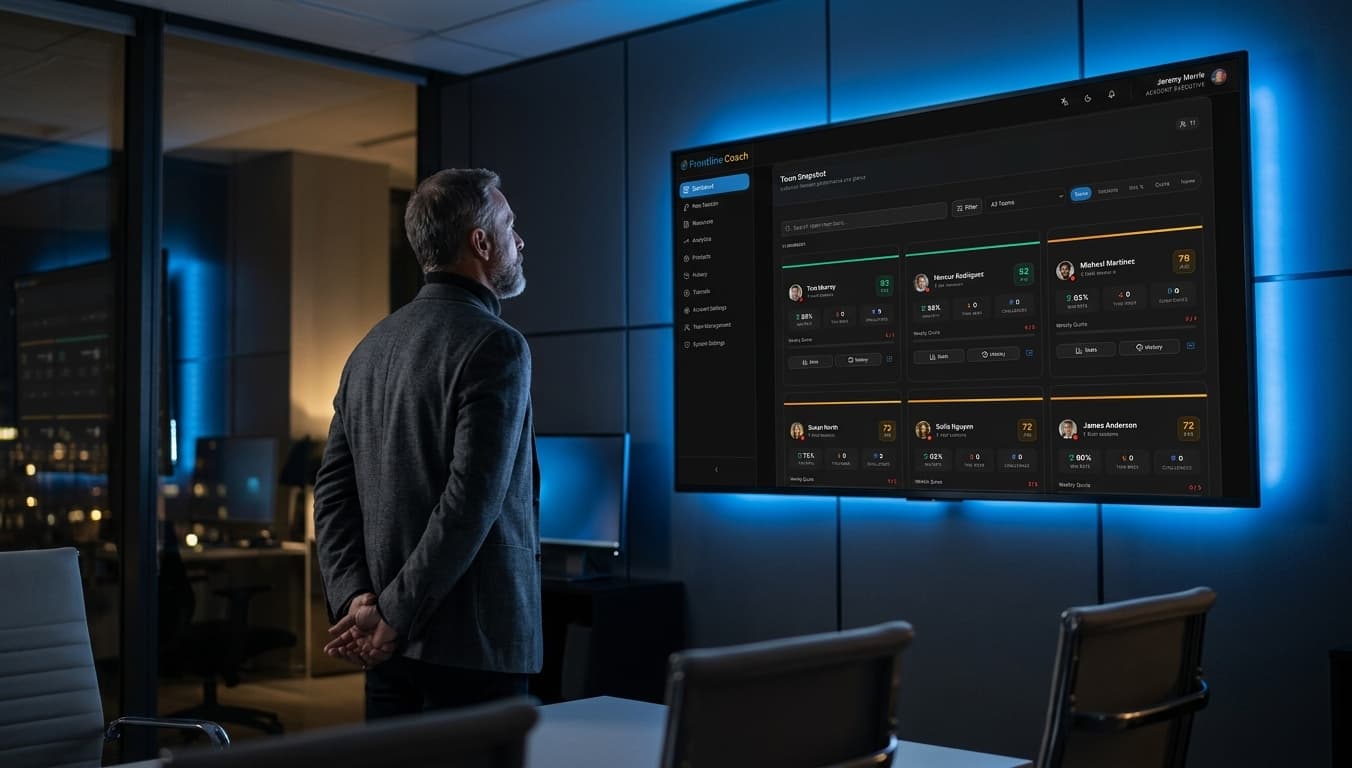
Frontline Coach's analytics dashboard is built for exactly this weekly data check — it surfaces which specific skills each rep is weak on based on scored roleplay sessions, so a manager can assign a short, targeted coaching challenge in minutes rather than building a session from scratch. That keeps the cadence lightweight enough to survive a busy pipeline, and it pairs directly with running 1:1s that are actually coaching and giving feedback reps actually use. Frontline Coach starts at $9.99/mo, self-serve, no sales call required.
Frequently asked questions
Why do most coaching cadences die within a quarter?
Because they're launched as a heavy new process — extra meetings, extra documentation, extra time nobody actually has — on top of an already full manager schedule. The first genuinely busy pipeline week gets used as the excuse to skip it once, and once a cadence has been skipped once, skipping it again is much easier.
What does a 'lightweight' cadence actually mean in practice?
A handful of specific, short touchpoints built into meetings that already exist — the coaching half of a 1:1, a five-minute look at scored roleplay data before a team meeting — rather than new meetings added on top of a manager's calendar.
How do I decide who gets coached on what each week?
Use data instead of guessing — scored roleplay sessions or call reviews that show specific skill gaps by rep, so a manager can target the rep who actually needs help with objection handling this week, instead of running the same generic training for everyone regardless of where they actually are.
Should coaching cadence be the same for every rep on the team?
No — a cadence that assigns the same generic topic to every rep every week, regardless of individual performance, tends to feel like busywork to reps who don't need it and misses the specific gap for reps who do. A lightweight cadence with rep-specific targeting, based on actual data, holds up better than a uniform one.
How does Frontline Coach support a coaching cadence without adding manager workload?
The analytics dashboard surfaces which specific skills each rep is weak on based on scored roleplay sessions, so a manager can assign a short, targeted coaching challenge in minutes rather than building a training session from scratch — keeping the cadence lightweight enough to actually survive a busy quarter.
Keep reading
What AI Sales Roleplay Software Actually Costs
Why most of the category won't show you a price — and what Frontline Coach charges instead.
The Practice Gap: Why Reps Learn on Live Customers
The core problem Frontline Coach exists to solve, and why reading a playbook isn't the same as practicing one.
How to Practice Renewal Conversations Before They Become Churn
A practical framework for rehearsing at-risk account conversations before the real one happens.