Run a 1:1 That's Actually Coaching
Most 1:1s get eaten entirely by pipeline review, leaving zero time for the skill coaching that's supposed to be the point of the meeting.
No demo required · No contracts · Cancel anytime
Quick answer
Time-box a 1:1 into two clearly separated halves: a short pipeline check covering only stuck deals or real decisions, then a deliberate, protected switch to coaching — discussing how a specific recent call actually went, or rehearsing an upcoming hard conversation out loud. Pipeline questions will always expand to fill the whole meeting unless the manager actively protects the coaching half as a non-negotiable block, not a nice-to-have if time allows.
Ask a rep what their weekly 1:1 with their manager is actually about, and most will describe a pipeline review: which deals moved, which are stuck, what's needed to push them forward. That's useful information, and it's also almost entirely visible in the CRM already. The 1:1 is supposed to be the highest-leverage coaching moment a manager gets with a rep — thirty uninterrupted minutes, one-on-one, no audience. Instead, in most sales and CX orgs, it's a status meeting that happens to be scheduled for two people instead of a whole team.
Why pipeline review always wins the time
Pipeline questions are urgent — a stuck deal has a deadline, a customer waiting on an answer, a forecast number due Friday. Coaching questions aren't urgent in the same way; a rep's discovery skills not developing doesn't have a deadline this week. Given unstructured time, the urgent thing always wins, which is exactly why coaching gets crowded out of 1:l after 1:1 without anyone deciding that on purpose. The fix isn't willpower — it's a structure that doesn't leave the split up to whatever feels most pressing in the moment.
A time-boxed structure that protects coaching
- Ten to fifteen minutes: pipeline, but only what needs a decision. Skip a full status readout — cover only deals that are stuck or need the manager's input.
- A deliberate, named switch. Say it out loud: “let's shift to talk about how the call with [account] actually went” — the explicit transition is what protects the second half from bleeding back into deal talk.
- Coaching on something specific. A real recent call, or a planned rehearsal of an upcoming hard conversation — not a general “how's it going” check-in.
- Hold new deal questions until the end. If an urgent pipeline question comes up mid-coaching, note it and return to it after, rather than letting it hijack the segment.
Short pipeline check
Deliberate switch
Protect the segment
What the switch actually sounds like
- “Okay, pipeline's covered — let's spend the rest of this on how the Acme call actually went. Walk me through the moment they brought up the competitor.”
- “Before we get into anything else, you've got that renewal call with a difficult account on Thursday — let's use the next ten minutes to actually run through how you'll open it.”
- “Let's hold that deal question until the end — right now I want to focus on the discovery call from Tuesday.”
Why practicing this beats just scheduling it differently
A manager can block thirty minutes and label half of it “coaching” on the calendar and still spend all thirty on pipeline the moment a rep mentions a deal in trouble. Protecting the switch is a live-conversation skill, not a scheduling one — it means being comfortable saying “let's come back to that” in the moment, which takes practice the same way any other hard conversation does. This is the practice gap showing up in management itself: the intention to protect coaching time is easy, holding the boundary live is harder.
Making the coaching half concrete with Frontline Coach
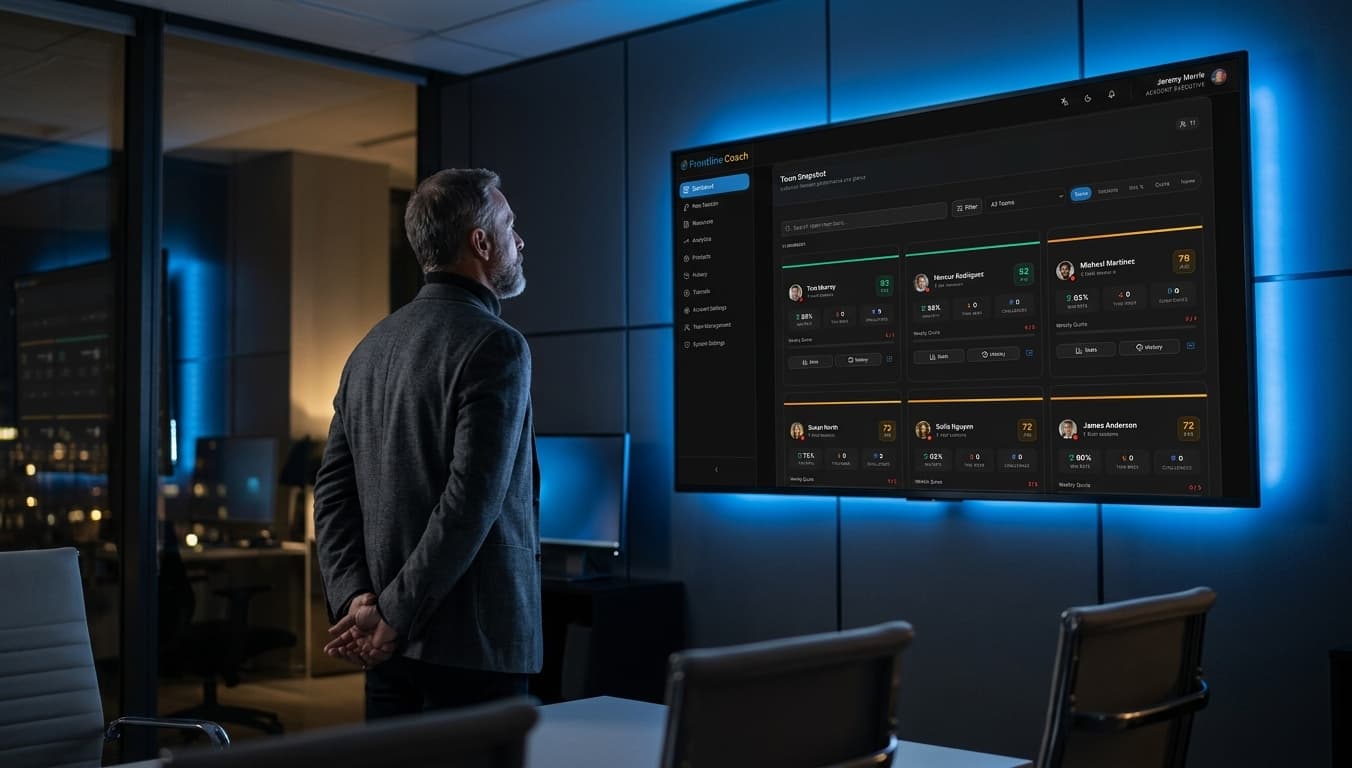
The coaching half of a 1:1 works best when it's about something specific, not a general check-in — and Frontline Coach's analytics dashboard gives a manager a scored roleplay session or recent call to point to directly, plus the ability to assign a rep a short, targeted practice scenario tied to an upcoming real conversation before the next 1:1. That turns “how's it going” into a concrete fifteen minutes of rehearsal. Pairs well with a consistent weekly coaching cadence and a structure for giving feedback reps actually use. Frontline Coach starts at $9.99/mo, self-serve, no sales call required.
Frequently asked questions
Why does pipeline review eat the whole 1:1?
Because it's urgent and coaching isn't — a stuck deal has a deadline, a skill gap doesn't. Without a deliberate structure that protects coaching time, pipeline questions will always expand to fill the available minutes, since there's always one more deal worth discussing.
How long should the pipeline portion of a 1:1 actually take?
Ten to fifteen minutes out of a thirty-minute 1:1, covering only deals that are stuck or need a decision — not a full walkthrough of every open opportunity. If pipeline review is taking longer than that, it usually means the manager is reviewing status that's already visible in the CRM instead of only discussing what actually needs a decision.
What if an urgent deal question comes up during the coaching half?
Note it and hold it for the end, or for an async follow-up, unless it's genuinely blocking. Protecting the coaching time only works if the manager treats it as a real boundary — the same one they'd protect for a customer call.
What does 'a planned practice moment' actually look like in a 1:1?
Instead of just discussing an upcoming hard conversation — a competitive deal, a difficult renewal — the manager has the rep actually say their opening line or handle an objection out loud, live, in the 1:1. It turns fifteen minutes of talking about the call into fifteen minutes of rehearsing it.
Can Frontline Coach make the coaching half of a 1:1 more concrete?
Yes — a manager can pull up a rep's most recent scored roleplay session and discuss a specific moment from it, or assign a short practice scenario tied to an upcoming real conversation, so the coaching half of the 1:1 has something concrete to work from instead of a general check-in.
Keep reading
What AI Sales Roleplay Software Actually Costs
Why most of the category won't show you a price — and what Frontline Coach charges instead.
The Practice Gap: Why Reps Learn on Live Customers
The core problem Frontline Coach exists to solve, and why reading a playbook isn't the same as practicing one.
How to Practice Renewal Conversations Before They Become Churn
A practical framework for rehearsing at-risk account conversations before the real one happens.