Run a Multi-Stakeholder Demo Without Losing the Room
A demo to a CFO, a VP Ops, and an IT lead at once usually fails by trying to be everything to everyone. Here's a structure that addresses all three without watering down the pitch.
No demo required · No contracts · Cancel anytime
Quick answer
A multi-stakeholder demo holds the room by opening with each stakeholder's specific stake in the outcome, running one core demo flow that stays audience-agnostic, and hitting planned pivot points that address each stakeholder's concern directly — cost for the CFO, workflow fit for Ops, security for IT — instead of a generic Q&A saved for the end. Frontline Coach lets AEs rehearse this exact room-management skill against AI stakeholder personas before doing it live.
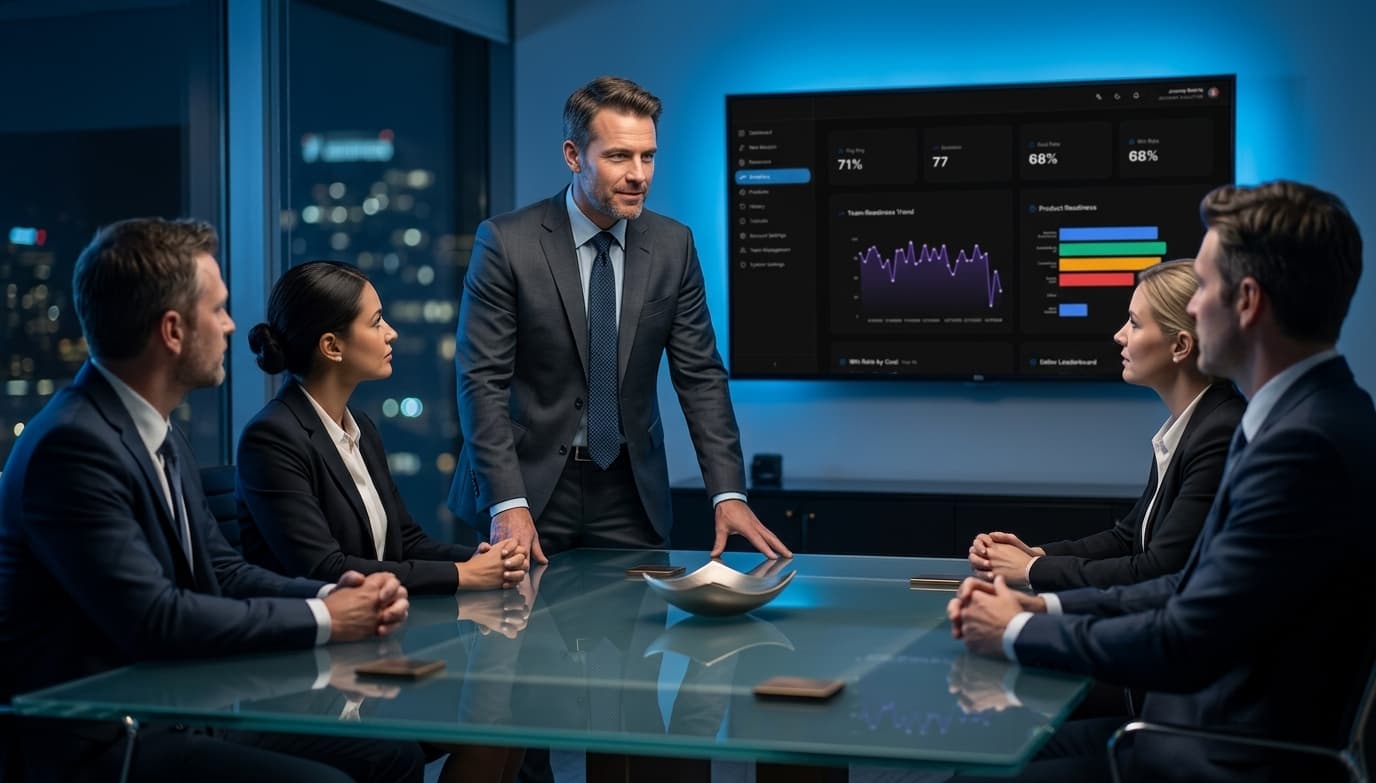
A demo to a single buyer is a manageable problem: understand what they care about, show it, answer questions. A demo to five stakeholders at once — a CFO, a VP of Operations, an IT lead, maybe an end-user champion and a procurement contact — is a different problem entirely, and most AEs solve it the wrong way. They either build one narrow pitch and hope it lands with everyone, which loses the room fast when half the audience doesn't see themselves in it, or they try to cover every angle for every person, which waters the whole thing down into something that satisfies nobody.
Why the “cover everything” instinct backfires
The instinct to address every stakeholder's concern in equal depth feels safe, but it produces a demo with no throughline — a little bit of ROI talk, a little bit of workflow detail, a little bit of security messaging, none of it connected to a clear central story. Stakeholders who are only half-addressed disengage, and in a room with several other people present, one disengaged, senior stakeholder changes the energy for everyone else. The fix isn't more coverage, it's structure: one clear flow, with specific, planned moments where each stakeholder gets addressed directly.
A structure that holds the room
Open by naming everyone's stake. Before the demo starts, say out loud why each person is in the room: “[CFO name], I know budget impact is the lens you'll be looking at this through. [Ops lead name], you'll be looking at how this actually fits your team's day-to-day. [IT lead name], integration and security are probably top of mind for you — we'll get to all three.” This single move tells every stakeholder they haven't been forgotten, before a single screen is shared.
Run one core flow built around the shared outcome. Anchor the whole demo to the single business result every stakeholder actually cares about — faster cycle time, fewer errors, whatever the deal's real driver is — and walk through it as one story, not five separate pitches stitched together. This keeps the room's attention even for stakeholders whose specific pivot hasn't come up yet.
Hit planned pivot points, not a Q&A at the end. Build two or three natural pause points into the flow where you turn and address a specific stakeholder directly. To the CFO, mid-demo: “This is the piece that maps to the ROI number we walked through — happy to go deeper on the math whenever works.” To Ops: “This is exactly where your team would plug in day to day — does that match how you'd expect it to fit?” To IT: “On the integration side, this connects through [specific method] — want me to go a layer deeper on that now, or hold it for a technical follow-up?”
Name every stake upfront
One flow, not five pitches
Planned pivots, not Q&A
Why practicing beats reading
Knowing the structure on paper doesn't make it easy to actually execute the pivots in the moment — reading the CFO's body language while still holding the Ops lead's attention, timing the turn to IT so it doesn't feel like an interruption. That's a live, multi-threaded skill, and most AEs only get real repetitions of it on actual deals, where the cost of losing the room is a stalled opportunity. This mirrors the account and stakeholder mapping formalized in Target Account Selling — knowing who's in the room is the input; running the room well is the practiced skill this guide is about.
Practicing multi-stakeholder demos with Frontline Coach
Frontline Coach lets AEs roleplay against AI personas built around different stakeholder concerns — a cost-focused persona, a workflow-focused persona, a security-focused persona — sometimes in the same simulated meeting, at escalating difficulty from Friendly to Balanced to Challenging. That makes it possible to rehearse the actual pivot-point timing this guide describes, not just read about it, before doing it live in front of a real buying committee. A related skill worth rehearsing alongside this one is holding your ground when the CFO's cost question turns into real pushback — see the price objection negotiation guide. Frontline Coach starts at $9.99/mo, self-serve.
Frequently asked questions
How do I structure a demo for a CFO, a VP Ops, and an IT lead in the same meeting?
Open by naming each stakeholder's stake in the outcome so everyone knows why they're in the room, run a core demo flow that stays audience-agnostic, and build in planned pivot points where you address each stakeholder's specific concern directly — cost and ROI for the CFO, workflow fit for Ops, security and integration for IT — rather than saving everything for a Q&A at the end.
Isn't it risky to address each stakeholder's concern mid-demo instead of waiting for questions?
It's riskier not to. If you wait for a generic Q&A at the end, the stakeholders who feel unaddressed disengage well before that point, and their silence in the room often reads as disinterest to everyone else present. Planned pivots keep every stakeholder anchored to something specific to them throughout, not just at the close.
How do I avoid watering the pitch down trying to cover everyone?
Keep one core demo flow built around the primary business outcome, and treat each stakeholder's concern as a pivot off that flow rather than a separate mini-demo. A demo that tries to be five different pitches stitched together loses the thread for everyone; one flow with well-timed detours holds attention and still lands each stakeholder's specific point.
How does this relate to Target Account Selling?
Target Account Selling formalizes the account and stakeholder mapping that should happen before this demo — identifying who's in the room and what each of them cares about. This guide picks up from there: once you know the stakeholders, here's how to actually run the meeting with all of them present.
Can Frontline Coach simulate a multi-stakeholder demo, not just a single buyer?
Yes. Frontline Coach lets AEs roleplay against AI personas representing different stakeholder concerns — cost-focused, workflow-focused, security-focused — so a rep can practice the pivot points and the room-management skill this guide describes before ever doing it live with real budget and real internal politics in the room.
Keep reading
What AI Sales Roleplay Software Actually Costs
Why most of the category won't show you a price — and what Frontline Coach charges instead.
The Practice Gap: Why Reps Learn on Live Customers
The core problem Frontline Coach exists to solve, and why reading a playbook isn't the same as practicing one.
How to Practice Renewal Conversations Before They Become Churn
A practical framework for rehearsing at-risk account conversations before the real one happens.